

Location
OnlineDate and time
-
INCCA is pleased to invite you to an upcoming INCCA Talk on 2nd April 2026 9am BST, where doctoral student Manon Abt, will moderate a talk on the preservation of Toshio Iwai’s Time Stratum series.
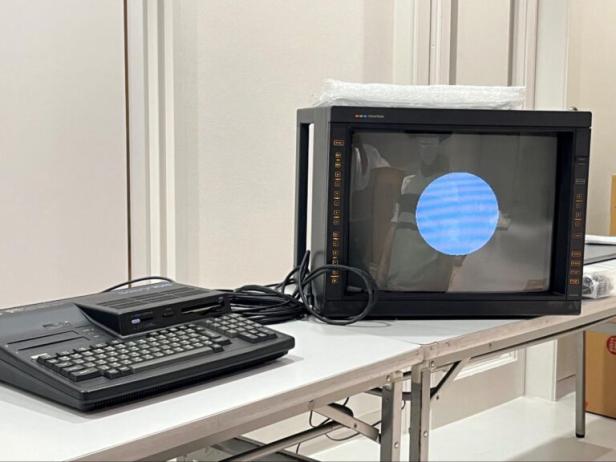
The restoration of Toshio Iwai’s Time Stratum series brings into focus the challenges of exhibiting and potentially acquiring early computer-based art. Created between 1985 and 1990, these video- and computer-based installations are the subject of an artist-driven restoration project initiated in 2023.
The talk brings together the Japanese team involved in the project, including Toshio Iwai, curator Hiroko Kimura-Myokam, conservator Tabei Katsuhiko, and web designer Shunya Hagiwara. The discussion will present the Time Stratum series as a case study to examine the strategies developed in response to exhibition requirements and institutional acquisition frameworks.
Situating the project within the context of Iwai’s ongoing archive and research initiatives and the renewed institutional attention to his work in Japan, the discussion will address broader questions relevant to media art conservation. These include technological authenticity, long-term preservation approaches, the role of artist intent, and the tensions between exhibition viability and museum acquisition policies. The session will conclude with a moderated discussion and audience questions.
English live captions and Japanese AI translation will be available.
Please sign up for free here.
Photo credit: Sato Motoi. Photo courtesy of Civic Creative Base Tokyo (CCBT)
Biographies:
Toshio Iwai is a media artist and author of children's books. He started making experimental animations during college and, in 1985, became the youngest recipient of the Contemporary Art Exhibition of Japan Awards for Time Stratum II, inspired by nineteenth-century animation devices like the phenakistiscope and zoetrope. He subsequently became a pioneering new media artist whose wide-ranging output includes the TV show Ugo Ugo Lhuga, the Bouncing Totoro exhibit at the Ghibli Museum in Mitaka, the Nintendo DS game Electroplankton, and the Tenori-on electronic musical instrument made for Yamaha. Iwai won the Golden Nica at Prix Ars Electronica for his 1996 performance with Sakamoto Ryuichi. He made his debut as a children's book author in 2006. His bestselling series, The House with 100 Stories, has sold 4 million copies. In 2022, a comprehensive overview of his career, "Which One's Which? Iwai Toshio: A Retrospective—A House of 100 Stories and Media Art"(2022), was held at the Museum of Modern Art, Ibaraki.
Katsuhiko Tabei is the CEO and representative director of MeAM Inc., which is engaged in the conservation and maintenance of media art works, focusing on long-term preservation and technical challenges. He completed the graduate program at the Institute of Advanced Media Arts and Sciences (IAMAS) in 2007 and has been producing media art works since his student years. He has also worked as an exhibition installer, primarily handling video and media-based works, and was involved in the installation of numerous works and exhibitions. In 2022, he participated in the launch of Civic Creative Base Tokyo (CCBT) as a technical director.
Shunya Hagiwara (b. 1984, Kawasaki, Japan) is a web director, programmer, and designer. He encountered media art at a technical high school and studied fine art at university while exploring net art and web design. After working at Semi-Transparent Design, he went independent in 2012 and now heads Studio Autumn, focusing on website development, accessibility, and digital archiving in the arts and culture sector.
Manon Abt is a PhD student in the History of Art Department of UCL, researching the preservation of early computer-based art (1960-1991) under the supervision of Prof Pip Laurenson. Her research examines conservation strategies and practices developed by museums, academic research groups, and artists to preserve and exhibit computer-based artworks. She assesses how the narratives used to restore these works relate to different conservation theories. She focuses on case studies of collections located in the United Kingdom, Poland and Japan. She was granted the Ishibashi Foundation/The Japan Foundation Fellowship for Research on Japanese Art in 2025 to research the preservation and conservation of new media art in Japan.
Before her PhD research, Manon worked on the links between nanotechnologies, art, and the infra-perceptible within the Arts and Sciences Chair of the École Polytechnique, the EnsAD-PSL, and the Carasso Foundation in France.
Hiroko Kimura-Myokam is a curator, archivist and researcher specialised in the preservation of media art and anime. She graduated from the School of Art and Design, University of Tsukuba, and the Institute of Advanced Media Arts and Sciences (IAMAS), and completed graduate studies in media art history at the University for Continuing Education Krems (Austria). After a stint as a curator at the NTT InterCommunication Centre (ICC), she began working on various projects and research related to archiving anime and media art. From 2013, she was involved in digitising and building a database of video art for the Inter Media Art Institute in Düsseldorf, Germany. In 2018, she founded Eizo Workshop with Kimura Noriyuki in Kaga City, Ishikawa, which strives to uncover dormant cultural and artistic resources and link them to future creativity. She is also a founding member of Toshio Iwai Archive & Research and a part-time lecturer at Kanazawa College of Art and Kyoto Seika University.